
2026-2027 Seed Grant Recipients

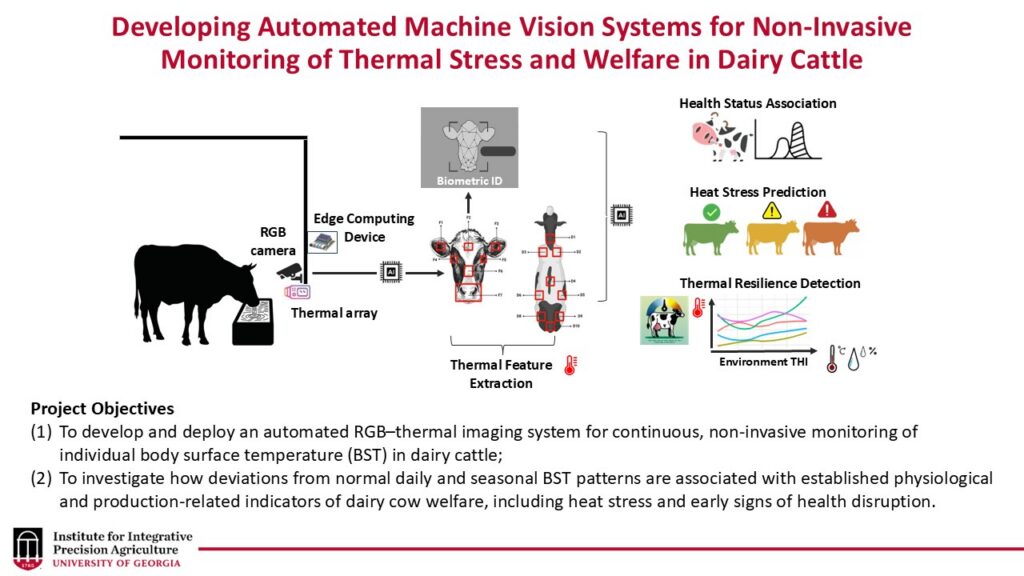
Developing Automated Machine Vision Systems for Non-Invasive Monitoring of Thermal Stress and Welfare in Dairy Cattle

PI: Anderson Alves, Department of Animal & Dairy Science, College of Agricultural and Environmental Sciences
Co-PIs:

  • Thirimachos Bourlai, School of Electrical and Computer Engineering, College of Engineering
  • Sha Tao, Department of Animal & Dairy Science, College of Agricultural and Environmental Sciences
A schematic of the methods the PIs will use to complete the project. The slide includes the title of the project at the top which is “Developing Automated Machine Vision Systems for Non-Invasive Monitoring of Thermal Stress and Welfare in Dairy Cattle.” The bottom of the image includes a text box with the project’s objective which are: (1) To develop and deploy an automated RGB–thermal imaging system for continuous, non-invasive monitoring of individual body surface temperature (BST) in dairy cattle; and (2) To investigate how deviations from normal daily and seasonal BST patterns are associated with established physiological and production-related indicators of dairy cow welfare, including heat stress and early signs of health disruption. The middle of the image shows how radiometric infrared sensors and RGB cameras installed at watering troughs will be used to identify unrestrained dairy cows using facial and body shape recognition, measure their body temperature, and determine their health status through the application of AI models.

Click to enlarge.

Vision-Guided Plant Surgical Robotics for Precision Miniaturized Sensor Implantation in Maize

PI: Xin Zhang, School of Environmental, Civil, Agricultural and Mechanical Engineering, College of Engineering

Co-PIs:

  • Leonardo Bastos, Department of Crop and Soil Sciences, College of Agricultural and Environmental Sciences
  • Liang Dong, School of Electrical and Computer Engineering, College of Engineering and Department of Crop and Soil Sciences, College of Agricultural and Environmental Sciences
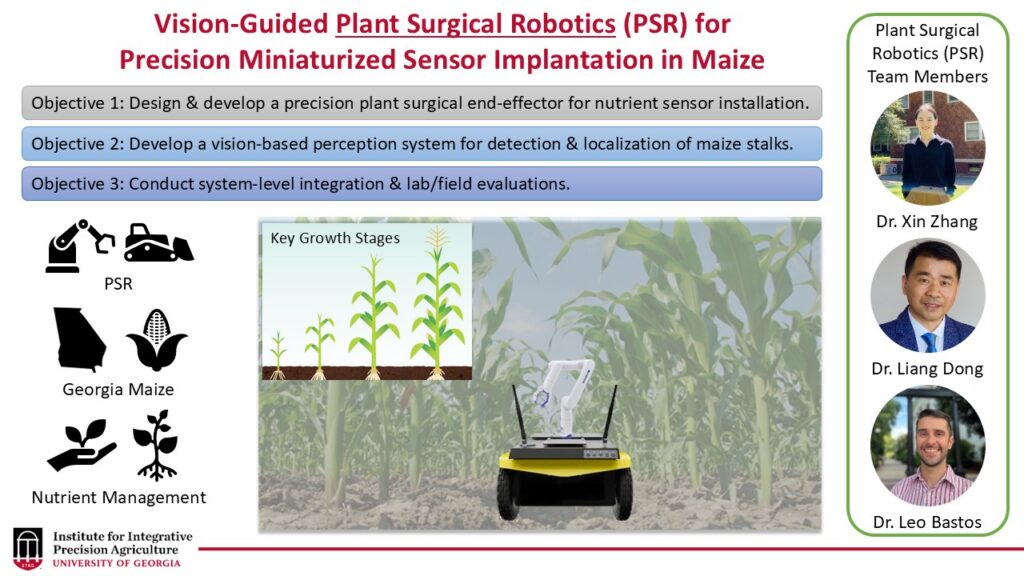
A schematic of the methods the PIs will use to complete the project. The slide includes the title of the project at the top which is “Vision-Guided Plant Surgical Robotics (PSR) for Precision Miniaturized Sensor Implantation in Maize.” Below the title, the project’s three objectives are listed. They are to (1) Design & develop a precision plant surgical end-effector for nutrient sensor installation; (2) Develop a vision-based perception system for detection & localization of maize stalks; and (3) Conduct system-level integration & lab/field evaluations. Below the objectives is a rendering of the robotic vehicle equipped with precision plant surgical end-effector in a corn field. To the left are icons representing the PSR, the state of Georgia and maize, and nutrient management. The right of the slide are photos and names of the project PIs: Dr. Xin Zhang, Dr. Liang Dong, and Dr. Leo Bastos.

Click to enlarge.

ROBO-Root3D: Miniaturized Robot for Underground Nondestructive 3D Root Phenotyping

PI: Beiwen Li, School of Environmental, Civil, Agricultural and Mechanical Engineering, College of Engineering

Co-PI: Zenglu Li, Department of Crop and Soil Sciences, College of Agricultural and Environmental Sciences
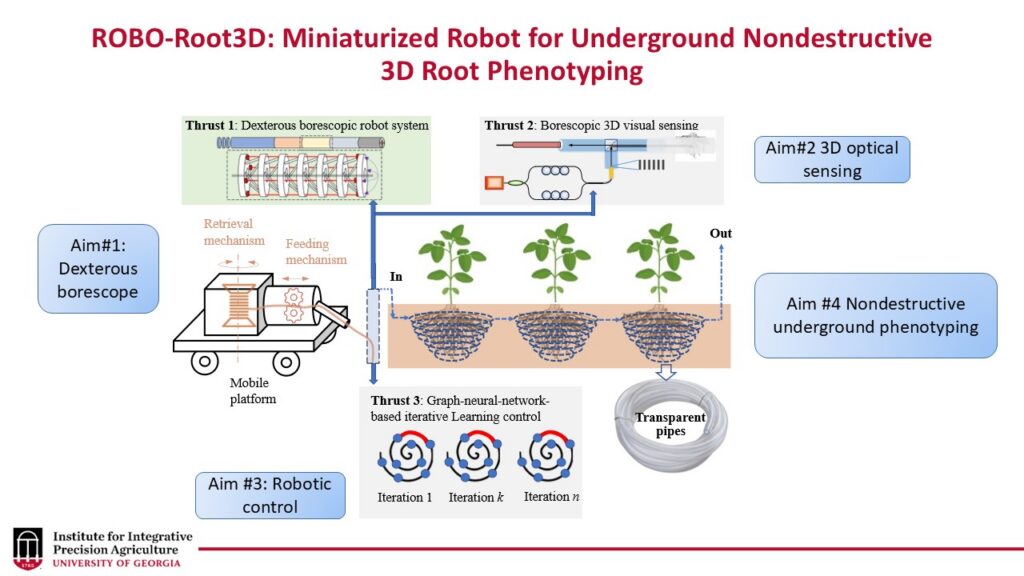
A schematic of the methods the PIs will use to complete the project. The slide includes the title of the project at the top which is “ROBO-Root3D: Miniaturized Robot for Underground Nondestructive 3D Root Phenotyping.” Bubble boxes include the project’s four general aims which are to develop a dexterous borescope; (2) integrate 3D optical sensing; (3) achieve robotic control; and (4) conclude by achieving underground root phenotyping. The schematics in the image show in sequence the proposed design of a miniaturized borescopic robot with high dexterity and embedded shape sensing; a schematic of the single-shot 3D borescopic optical sensing framework which will be used for accurate reconstruction of complex root structures; a depiction of a graph neural network driven motion generation and iterative learning control for reliable navigation in confined underground environments; and validation of the system through field trials using soybean lines.

Click to enlarge.

A Novel Sensor for Rapid Quantitative Detection of Campylobacter Contamination for Poultry Safety Applications

PI: Ramaraja Ramasamy, School of Chemical, Materials and Biomedical Engineering, College of Engineering

Co-PI: Aaron Bodie, Department of Poultry Science, College of Agricultural and Environmental Sciences

A schematic of the methods the PIs will use to complete the project. The slide includes the title of the project at the top which is “A Novel Sensor for Rapid Quantitative Detection of Campylobacter Contamination for Poultry Safety Applications.” Below the title and to the left is listed the project goal, which is to develop a portable, simple-to-use diagnostic tool for rapid detection and monitoring of Campylobacter spp. contamination for poultry industry applications. Below that the projects four objectives are listed. The objectives are (1) electrochemical biosensor development for Campylobacter detection; (2) analytical performance characterization of the biosensor; (3) validation in poultry-relevant food, water, and surface matrices; and (4) machine learning-based optimization of biosensor performance. To the right of the goal and objectives are drawings show how electrochemical sensing with will be achieved by engineering a portable, low-cost, rapid detection platform specifically designed to quantify Campylobacter. Machine learning will be used to analyze the data and maximize detection and accuracy and performance. The process will be used for proactive farm biosecurity.

Click to enlarge.

Smart Ultrasonic Cavitation System for Pathogen Control and Water Quality Management in Hydroponic CEA Facilities

PI: Md Sultan Mahmud, Department of Plant Pathology, College of Agricultural and Environmental Sciences

Co-PIs:

  • Benjamin Davis, School of Environmental, Civil, Agricultural and Mechanical Engineering, College of Engineering
  • Ruchika Kashyap, Department of Plant Pathology, College of Agricultural and Environmental Sciences
  • Whitney Pagan, School of Environmental, Civil, Agricultural and Mechanical Engineering, College of Engineering
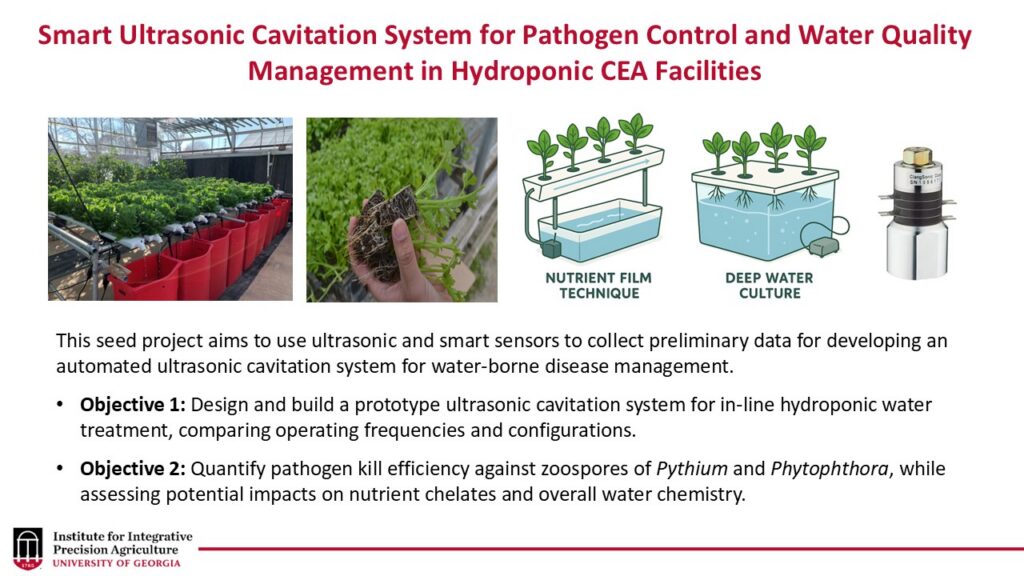
A schematic of the methods the PIs will use to complete the project. The slide includes the title of the project at the top which is “Smart Ultrasonic Cavitation System for Pathogen Control and Water Quality Management in Hydroponic CEA Facilities.” The bottom of the slide includes the aim of the project which is to use ultrasonic and smart sensors to collect preliminary data for developing an automated ultrasonic cavitation system for water-borne disease management. The two project objectives are listed below the aim. The objectives are to (1) design and build a prototype ultrasonic cavitation system for in-line hydroponic water treatment, comparing operating frequencies and configurations; and (2) Quantify pathogen kill efficiency against zoospores of Pythium and Phytophthora, while assessing potential impacts on nutrient chelates and overall water chemistry. Between the title and the aim and objectives are two photos of plants in a greenhouse and two drawings of hydroponic systems. The first shows hydroponic culture using the nutrient film technique and the second using the deep culture technique. Finally, there is a drawing of an ultrasonic transducer used for creating cavitation.

Click to enlarge.

A Fully Integrated System for Continuous Monitoring of Airborne Infectious Diseases in Poultry Production Environments

PI: Liang Dong, School of Electrical and Computer Engineering, College of Engineering and Department of Crop and Soil Sciences, College of Agricultural and Environmental Sciences

Co-PIs:

  • Lilong Chai, Department of Poultry Science, College of Agricultural and Environmental Sciences
  • Binu Velayudhan, Department of Infectious Diseases, College of Veterinary Medicine
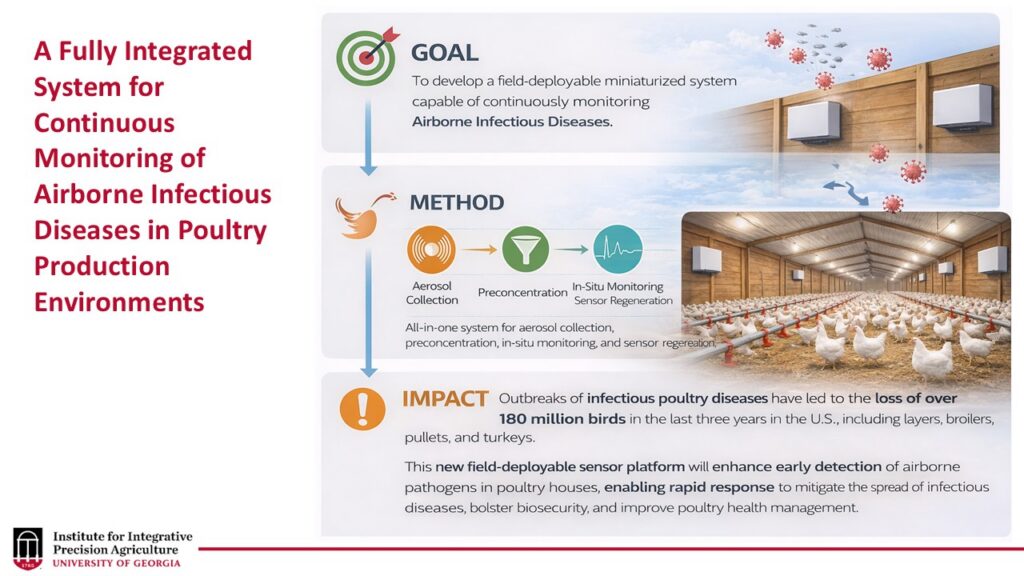
A schematic of the methods the PIs will use to complete the project. The project title which is “A Fully Integrated System for Continuous Monitoring of Airborne Infectious Diseases in Poultry Production Environments” is on the third left of the slide. The remainder of the slide contains three panels. The top panel contains the project goal which is to develop a field-deployable miniaturized system capable foo continuously monitoring airborne infectious diseases. The panel also includes cartoon-character viruses floating towards a poultry house. The second panel describes the project methods which are to develop an all-in-one system for aerosol collection, preconcentration, and in-situ monitoring and sensor regeneration. The panel contains a photo of white chickens within a poultry house. The third panel includes text describing the potential impact of the project which is to limit outbreaks of infectious poultry diseases by developing a field-deployable sensor platform that will enhance early detection of airborne pathogens in poultry houses, enabling rapid response to mitigate the spread of infectious disease, bolster biosecurity, and improve poultry health management.

Click to enlarge.